


“The white rabbit got her.”
That’s what we say now when someone has been transformed. When they have crossed a threshold they can’t come back from. When the before and after are stark.
It’s a TikTok trend. A meme. A shorthand for breakdown, breakthrough, the moment everything changes.
She left the marriage. She quit the job. She moved across the country, or oceans. She cut her hair. She stopped performing.
The white rabbit got her - and she walked away.
But it’s not new.
Alice fell down the rabbit hole in 1865.
And she’s been falling ever since.
⚠️ Trigger Warning
This essay discusses dissociation as survival mechanism, body autonomy, gaslighting, and the historical lack of rights for women. If you’re navigating your own rabbit hole right now, please read with care.
Alice’s Adventures in Wonderland was published in 1865.
What was happening to women in 1865?
No legal personhood. Women were property, first of fathers, then of husbands.
No right to vote.
No right to own property.
No bodily autonomy.
Marital rape was legal. Reproductive control was nonexistent.
Marriage was strategic, arranged, transactional.
Not chosen.
Not love.
And opium? Laudanum? Legal. Socially acceptable. Prescribed to women for everything from menstrual cramps to “hysteria” to just existing.
Alice is a girl on the edge of womanhood.
And Wonderland? Wonderland is what her mind creates to process the nightmare waiting for her.
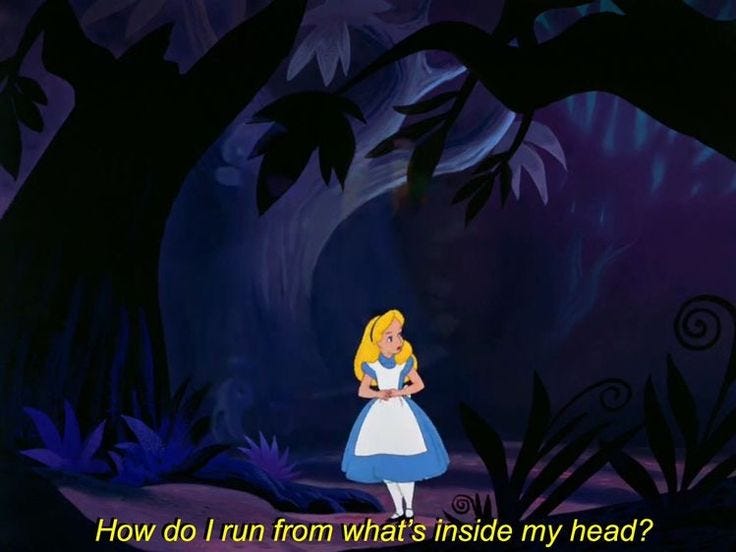
Dissociation is what happens when reality becomes too much to hold.
Your mind creates an alternate space. A place where the rules are different—or don’t exist at all.
Alice follows the white rabbit and falls.
And suddenly, she is in a world where:
Nothing makes sense
Her body changes uncontrollably
Authority figures are arbitrary and violent
She is constantly told she is wrong, rude, confused (that’s my favourite one)
The rules shift constantly but she is punished for not knowing them
This isn’t whimsy.
This is her subconscious processing the violence of the real world - the one where she has no rights, no autonomy, no exits.
Wonderland isn’t chaos. It’s trauma processing.
So off down the rabbit hole.. when reality is unbearable.
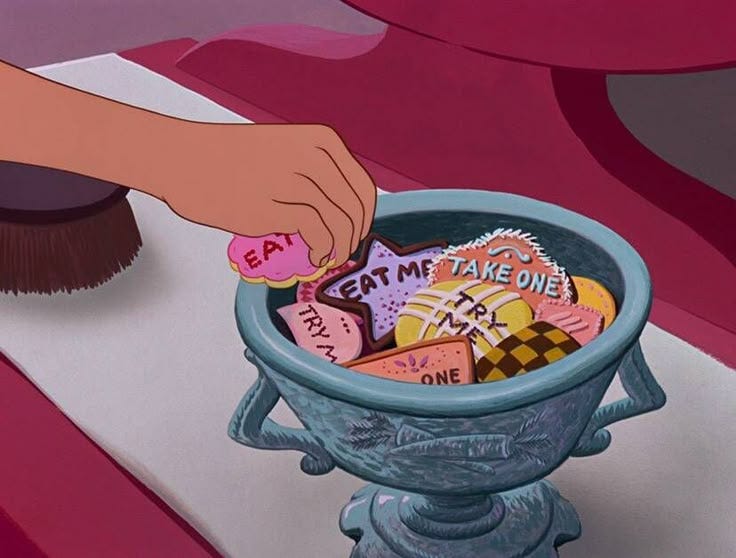
Alice eats. She drinks. Her body changes.
Too big. She fills the entire house. She is monstrous. She takes up too much space. She is stuck - literally can’t fit in the domestic space assigned to her.
Too small. She’s vulnerable. Dismissed. Nearly drowned in her own tears.
Never “right.”
This is the body horror of becoming a woman in 1865:
Puberty changes your body without your consent…
Pregnancy will make you “too big”..
Being small keeps you powerless…
Beauty standards demand you shrink…
Either way, your body isn’t yours…
The substances she consumes - “Eat me,” “Drink me” - change her against her will.
She has no control.
Just like she will have no control over:
Who she marries…
When she gets pregnant…
What happens to her body…
Whether she can leave..
Wonderland shows her: your body will never be yours to control.
“Who are YOU?”
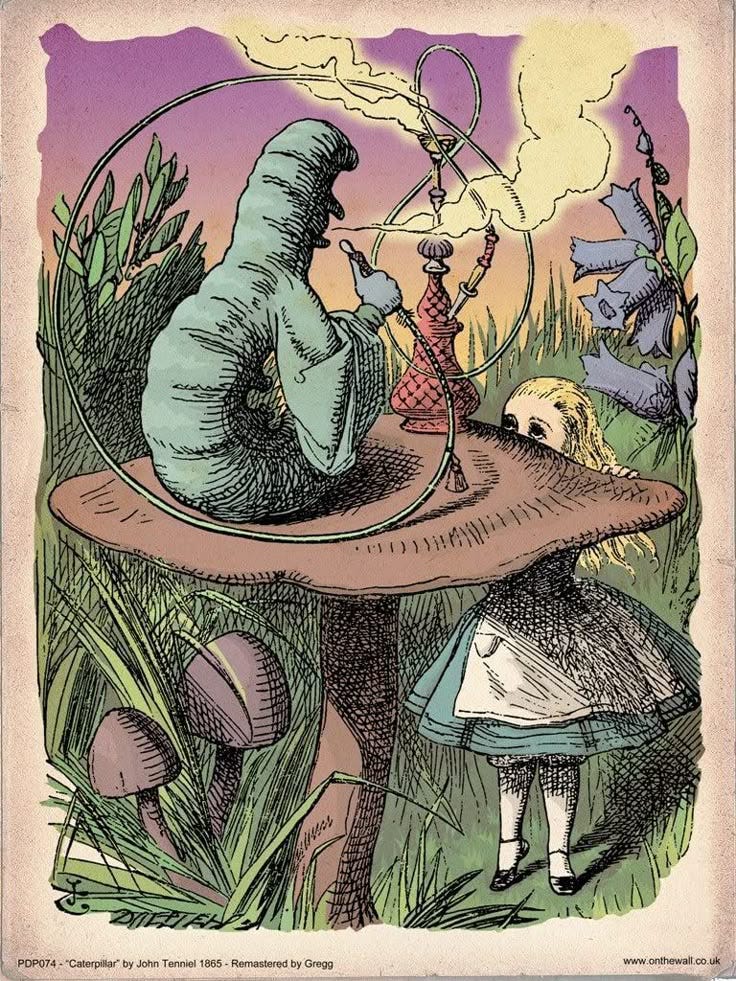
The Caterpillar chills on a mushroom, smoking a hookah. He looks at Alice and asks:
“Who are YOU?”
She tries to explain. She stumbles. She can’t answer clearly.
“I - I hardly know, sir, just at present - at least I know who I was when I got up this morning, but I think I must have changed several times since then.”
This is dissociation.
This is what happens when the world is about to erase you.
Because Alice is about to become:
Someone’s daughter (property)
Someone’s wife (property)
Someone’s mother (function)
But never just Alice.
She is losing her name. Her self. Her personhood.
“Who are YOU?”
The question isn’t philosophical.
It is the question every woman asks when the world tells her she doesn’t get to be a person.

Every character in Wonderland gives Alice different, contradictory instructions.
The Cheshire Cat gives directions that lead nowhere.
The Mad Hatter asks riddles with no answers.
The Queen of Hearts screams “Off with her head!” for no reason at all.
Alice is trying to be polite. Logical. Correct.
And it doesn’t matter.
Because the rules aren’t real. They are arbitrary. They shift based on who is in power.
Sound familiar?
This is what it means to navigate patriarchy:
Be confident but not aggressive.
Be assertive but not bossy.
Be professional but warm.
Be quiet but not too quiet.
Be visible but not too much.
The rules change constantly. And you’re punished for not knowing them.
The Queen’s violence is irrational. Arbitrary. Constant.
But Alice has to stay calm. Polite. Rational.
She can’t fight back. She has to navigate the chaos without becoming “hysterical.”
Because that’s what is expected of women: composure in the face of irrational authority.
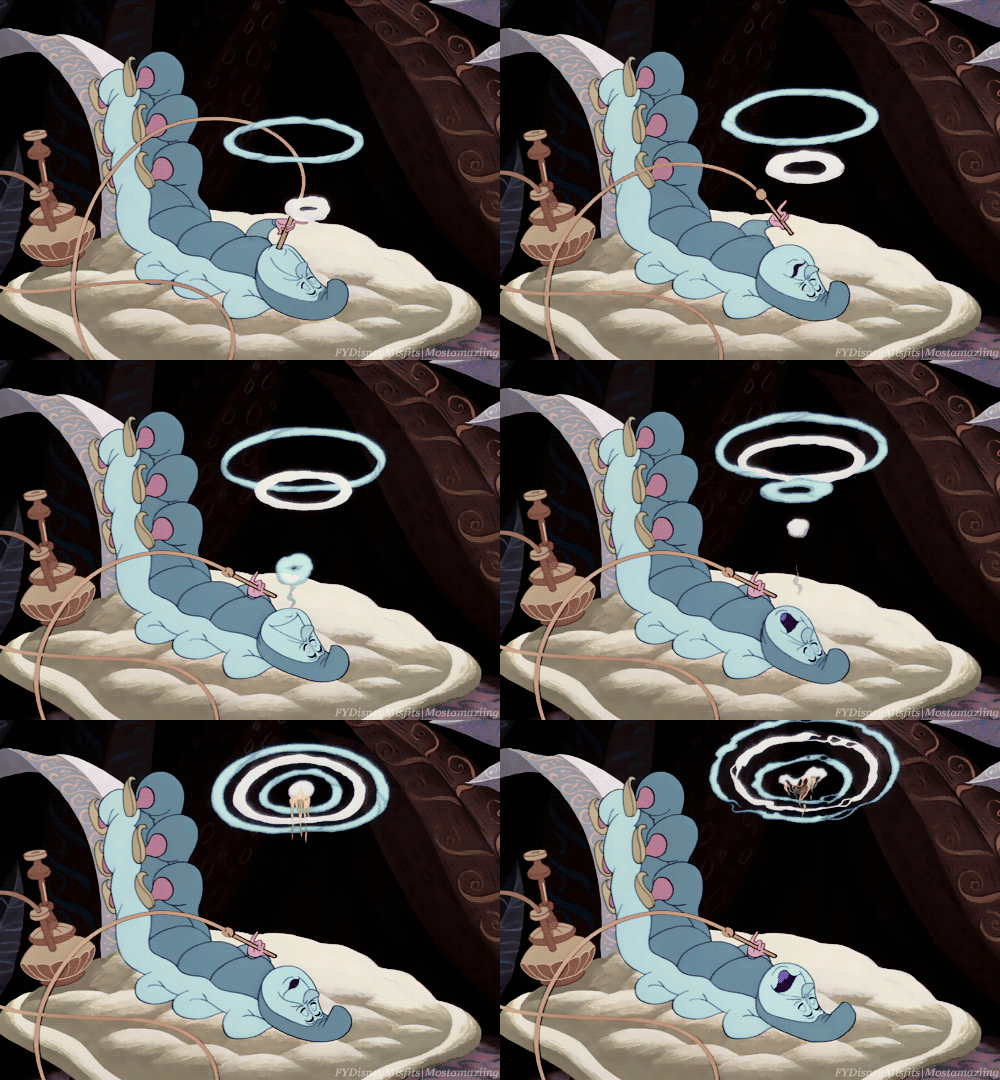
The Caterpillar smokes opium. Alice consumes substances that alter her body.
In the 1860s, opium and laudanum were legal and widely prescribed - especially to women.
For menstrual pain. For “nervousness.” For hysteria (which is a completely different piece I still need to write!). For existing in a world with no autonomy.
Addiction was common. Dissociation was survival.
The substances in Wonderland aren’t metaphorical.
They are real.
They are what women used to cope with a reality that offered no exits.
You can’t leave your marriage. You can’t own property. You can’t work independently. You can’t vote.
So you dissociate.
You fall down the rabbit hole.
You let your mind go somewhere else - because your body has to stay.

At the end of the story, Alice wakes up.
It was all a dream. Waking up from falling asleep at the foot of the tree.
But here’s the kicker: She doesn’t escape anything.
She wakes up into the same world.
The world where women have no rights.
Where marriage is ownership.
Where bodies are controlled.
Where autonomy doesn’t exist.
Wonderland was the dissociation.
Waking up is the horror.
Because now she has to face reality again and reality is worse than the dream.
She can’t stay in Wonderland. But she can’t change the real world either.
So what does she do?
She falls again. And again. And again.
Because dissociation isn’t dysfunction when reality offers no doors.
It’s survival.

Tim Burton knew: Alice is a warrior (but she still had to fall first).
In 2010, Tim Burton made Alice in Wonderland into something else.
Adult Alice returns to Wonderland. She is facing an arranged marriage in the real world - strategic, not chosen, exactly like 1865.
She falls down the rabbit hole again.
And this time, she fights.
She wields a sword. She slays the Jabberwocky. She becomes a warrior.
She returns to the real world and refuses the marriage. She chooses business. She chooses herself.
Burton made the subtext text: Alice in Wonderland is about a woman escaping a world that wants to control her, processing that violence through surrealism, and then - when she wakes up - choosing differently.
But even in Burton’s “empowered” version?? She still had to fall first.
She still had to go to Wonderland.
She still had to dissociate.
She still had to break before she could fight.
That is the pattern.
Women have to shatter themselves before they can refuse the world that wants to control them.
The white rabbit got her. And she came back different.
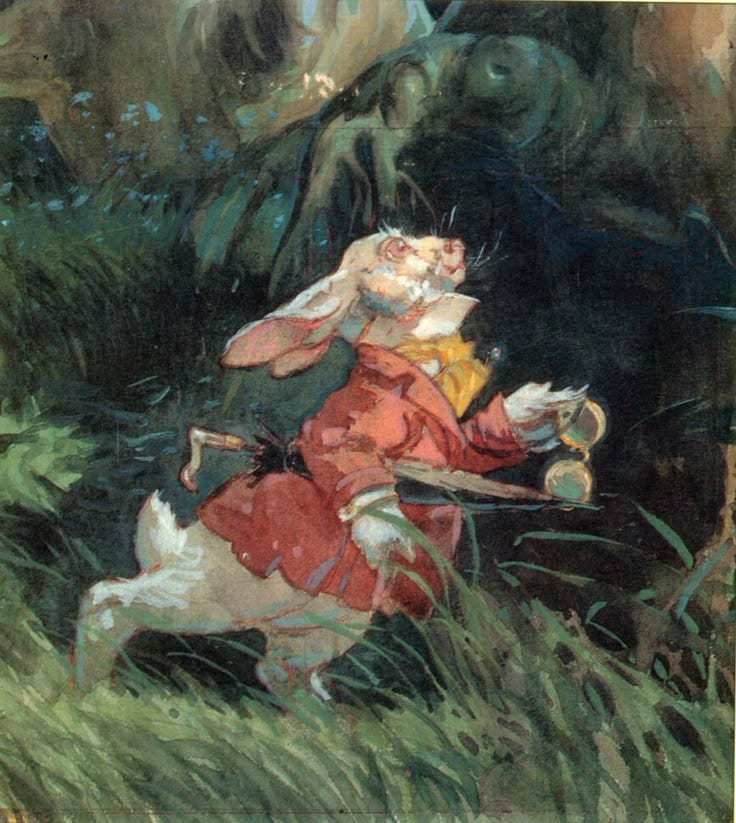
It’s fascinating, that modern trend. And yet it is different.
“The white rabbit got her.”
We say it now when a woman transforms.
When she has a breakdown.
When she leaves the marriage.
When she quits the job.
When she cuts her hair.
When she moves.
When she stops performing.
When something breaks her open and she comes back changed.
The trend celebrates transformation with agency. She fell. She processed. She walked away.
She rebuilt. She claimed her life. She refused to go back.
That is the difference.

But Alice.. couldn’t walk away
There is something cruel about what that modern trend has that Alice didn’t.
Agency.
In 1865, women had no legal exits.
You couldn’t leave a marriage (divorce was nearly impossible).
You couldn’t own property.
You couldn’t work independently.
You couldn’t vote.
You couldn’t even have legal personhood.
So Alice falls down the rabbit hole - processes the nightmare - and wakes up right back into it.
With no power to change anything except her own mind. She transforms internally. But she has no agency to transform externally.
The only thing that shifts is her and that’s not enough to save her.
Here’s the truth Alice knew:
Once you fall - once you see the nightmare clearly - you can’t unsee it.
You can’t go back to before.
Your mind has changed. Your self has changed.
Alice had to return to a reality that didn’t match her transformation.
You don’t.

So, the white rabbit got you. Now what?
You fell. You dissociated. You processed the nightmare.
You woke up different.
And you can’t go back to who you were before the rabbit hole.
But unlike Alice - you don’t have to.
Because the world has doors now.
Legal exits. Rights. Choices.
You can leave the marriage.
You can quit the job.
You can move.
You can rebuild.
The transformation doesn’t have to stay internal.
You can walk through the doors Alice never had.
Alice falls because she has no other choice.
Wonderland is the only place her mind can go when reality offers no doors.
But you? You have doors.
The white rabbit got you.
You fell.
You saw the truth.
You transformed.
And now you get to decide:
Do you wake up and return to the same reality?Or do you wake up and build a different one?
Alice couldn’t choose.
You can.
If the white rabbit got you, just know you are not alone.
And you don’t have to go back.
Alice had to return to a world that didn’t match her transformation.
You don’t.
You have agency she didn’t.
You have exits she couldn’t access.
You have rights she never had. Because women fought and gave their lives for those right and won.
The rabbit hole showed you the truth.
Now use it.
Walk through the doors.
Rebuild the world.
Refuse to go back.
Alice is still falling.
You don’t have to be.
Until next Friday,
Stay transformed. Stay awake. Stay free.
– Jen
!! If You Need Support !!
If this piece stirred something painful—if you’re in your own rabbit hole, if you’re dissociating to survive, if you’re trying to find the doors—please know you’re not alone, and you deserve care.
Mental Health & Dissociation Support
Crisis Text Line (US/UK/CA): Text HOME to 741741
Samaritans (UK): Call 116 123
Mind (UK): https://www.mind.org.uk
NAMI (US): https://www.nami.org
Lifeline (Australia): Call 13 11 14
Therapy for Black Girls: https://therapyforblackgirls.com
Inclusive Therapists: https://www.inclusivetherapists.com
Trauma & PTSD Resources
RAINN (US): 1-800-656-HOPE (4673)
National Domestic Violence Hotline (US): 1-800-799-SAFE (7233)
Refuge (UK): 0808 2000 247
Women’s Aid (UK): https://www.womensaid.org.uk
Substance Use Support
SAMHSA National Helpline (US): 1-800-662-4357
Alcoholics Anonymous: https://www.aa.org
Narcotics Anonymous: https://www.na.org
SMART Recovery: https://www.smartrecovery.org
You are not broken. Dissociation is survival. And you deserve doors - not just rabbit holes.
I came to this through a literary mag. Great piece. I was raised by a CSAM producer, and it wasn't until around age 40 after I was held hostage and that trauma was fully reactivated did I realize how often I'd been dissociating. It was like I'd never lived most of my life, even with receipts.
Loved this, thank you! The parallels to the reality of women of the era (and years beyond still) really cut deep. I also think about the speculation that Lewis Carroll might have been on the autism spectrum, so the confusing world of Wonderland makes even more sense. I feel like for anyone in a position where the societal "rules" were too rigid (I'm assuming many people felt that way), Alice's story might have been relatable.