

Let Down Your Hair
Blonde and wild? Locked away. Brunette and safe? Wife material - how romantic.

Breakup. Breakdown. Breakout.
That’s when women cut their hair. Right?
Not before - and never because a man decides it’s time.
The post-trauma haircut isn’t aesthetic. It’s somatic.
It’s what happens when the body says: We’re not going back there.
So, we need to talk about Rapunzel.
⚠️ Trigger Warning
This essay discusses imposed bodily autonomy, aesthetic regulation of women, punishment for female desire, body image standards, and the cultural messaging that freedom requires diminishment. If you’re exhausted from being told to dim yourself to be safe, this piece sees you - and refuses to look away.
Please read with care.
A girl is locked in a tower by a witch. She has impossibly long, golden hair. So long a prince can climb it to reach her. They fall in love. She gets pregnant. The witch discovers it. The witch cuts Rapunzel’s hair as punishment. For wanting, for choosing, for being sexual.
Rapunzel is banished to the wilderness to give birth alone. The witch uses the severed braid to lure the prince back to the tower. He climbs. She lets go. He falls into thorns and is blinded. He wanders blind for years. Eventually, he finds Rapunzel - now living in poverty with their twins.
Her tears fall on his eyes when she sees him hurt. His sight is restored.
They return to his kingdom and live happily ever after. Right?
That’s the Grimm version. And then Disney remade it.
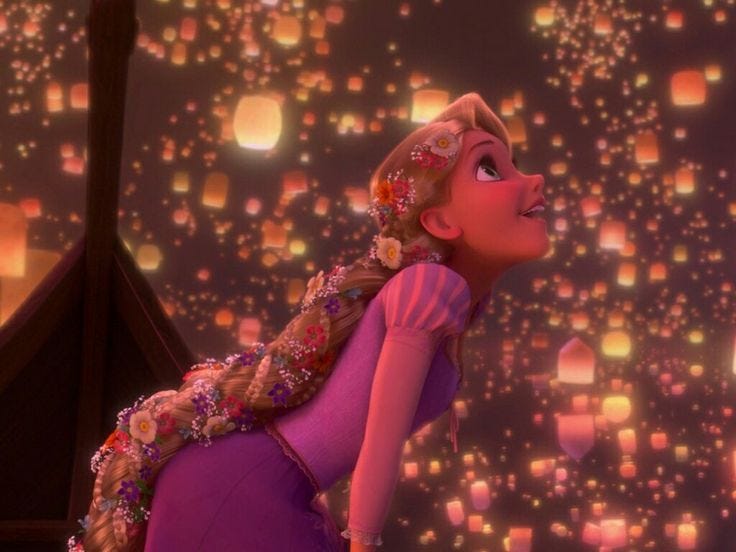
Credit: Disney
In Disney’s version, Tangled, Rapunzel isn’t punished for desire. She’s “liberated.”
The moment they call her free doesn’t come when she escapes the tower.
It comes when Flynn Rider - the love interest - cuts off her hair.
Her braid: gone. Her golden glow: gone.
Her power, radiance, otherworldly visibility - dimmed, dyed, and cropped.
She goes from glowing blonde to ‘plain’ brunette.
And we’re told this is empowerment.
But all of us women know better. Don’t we?
We’ve seen this move before.
The Glow-Down is a woman’s Happy Ending…
The fairy tale teaches us that..
Freedom requires sacrifice.
Power must be visualised, then minimised.
To be loved, you must be made smaller.
Your glow is dangerous, so give it up.
Wild women get locked away; tame women get chosen.
And it infuriates me. Because what? We are only worth if we are obedient? Palatable?
The fairy tale misses completely that…
In Grimm, the haircut is punishment for female desire.
In Disney, it’s imposed by a man and framed as liberation.
In both, she doesn’t choose it. It’s done TO her!
The result is the always same: her glow is removed, and we’re told this is the right ending.
This is the lie the fairy tale sold us. That freedom and radiance are incompatible.
That to be free, you must become less threatening to look at.
That dimming yourself is the price of being loved.
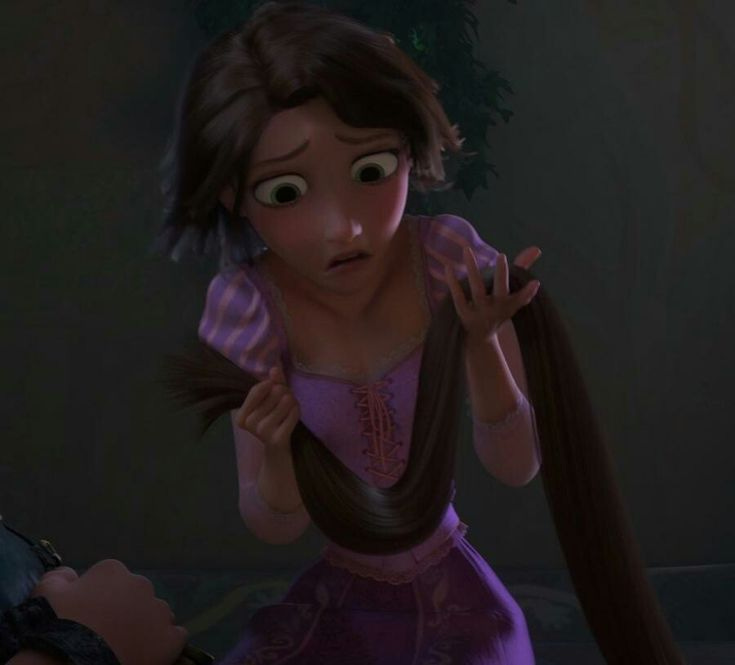
Credit: Disney
The Double Bind strikes once again: Wild and captive, or tame and chosen.
Here is what bothers me about Tangled specifically.
Rapunzel is portrayed as strong-willed. I loved that. Her singing, dancing, the song “When will my life begin”? or “I have a dream” Makes me laugh and cry whenever I watch it. The themes of belonging and longing hit hard every time. (That is another essay for an Inner Closet piece.)
Anyway.. the subtext underneath her “liberation” is brutal and multi-layered.
Flynn cuts her hair to “save” her. She doesn’t choose it. It’s done TO her.
and Freedom? Freedom equals aesthetic downgrade (or worse, aesthetic compliance). Blonde and wild becomes brunette and safe.
The message that is hidden in that subtext?
Glowing, powerful women are locked away. Dimmed, tame women are wife material.
You can be radiant and captive. Or plain and free.
But you can’t be powerful AND chosen.
This isn’t liberation. It’s control dressed as freedom.
This is the part where we need to talk about the male gaze.
I come right out with it: The male gaze decides which version of you is acceptable.
Repeat that again: The male gaze decides which version of you is acceptable.
So, let’s be clear about what’s really happening here.
Blonde Rapunzel - glowing, wild, powerful - is too much. She’s desired, yes. But she’s also threatening. Her radiance draws attention. Her magic makes her dangerous. Her wildness makes her uncontrollable.
So she’s locked away.
Not to protect her. To contain her.
And when she’s finally “freed,” the first thing that happens? Her glow is cut away.
Because the male gaze doesn’t just want you beautiful.
It wants you beautiful and manageable.
Radiant enough to desire. Dimmed enough to control.
Wild enough to be exciting. Tame enough to marry.
Brunette Rapunzel - plain, safe, softened - is wife material. And that’s the trade we’re told to accept.
Your power for his love.
Your glow for his approval.
Your wildness for his comfort.
This isn’t liberation. This is grooming you for captivity with better lighting.

As a fashion psychologist, I study how appearance isn’t just expression - it’s regulation.
Hair. Clothing. Style. They’re not just about how we look. They are how the nervous system negotiates safety.
Women DO cut their hair after trauma.
I have. Many times in fact.
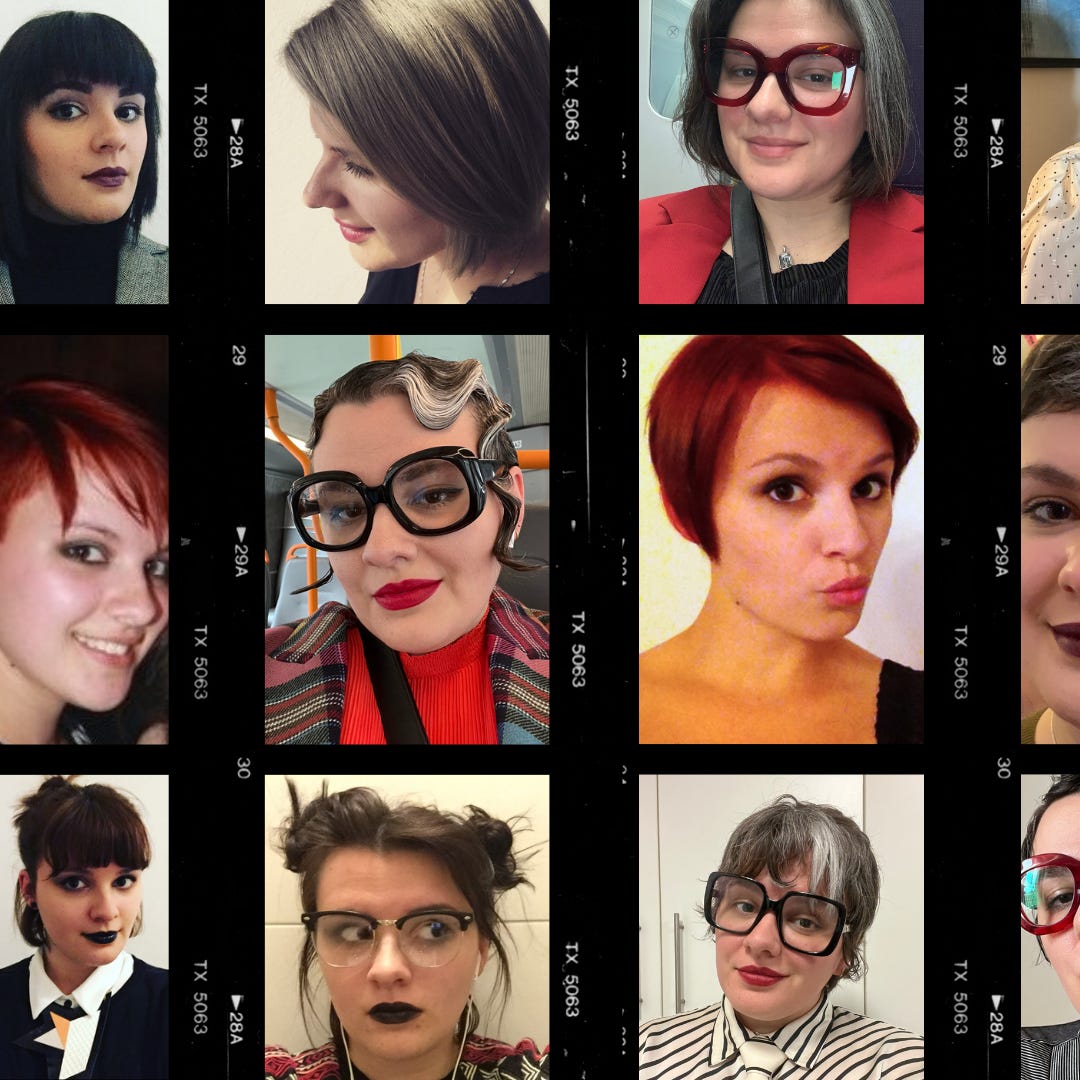
Me over the years - I know.. shocking
Every milestone I’ve had - ugly breakups, moving to Berlin, moving to New York, needing a fresh start - I cut or dyed my hair. Or straightened it, or left it naturally wavy-curly. Anything at any cost to make me look different.
It was always a strong indicator. A somatic boundary marker between before and after.
Hair became my way of saying: We’re not going back there.
But here’s the difference: When I chose it, it was reclamation.
When it’s imposed - just like Rapunzel’s haircut - it’s containment.
The post-trauma haircut isn’t cosmetic. It’s survival logic. It means you are choosing yourself. To step into a new, free version that follows after your trauma.
But in Tangled, Rapunzel doesn’t get that choice. The haircut isn’t hers. The closure isn’t hers. The change isn’t hers.
Her visual transformation is imposed. And we’re told it’s empowerment?!
Because now she’s soft. Now she’s brunette. Now she’s safe.
Now she’s ready to be loved.
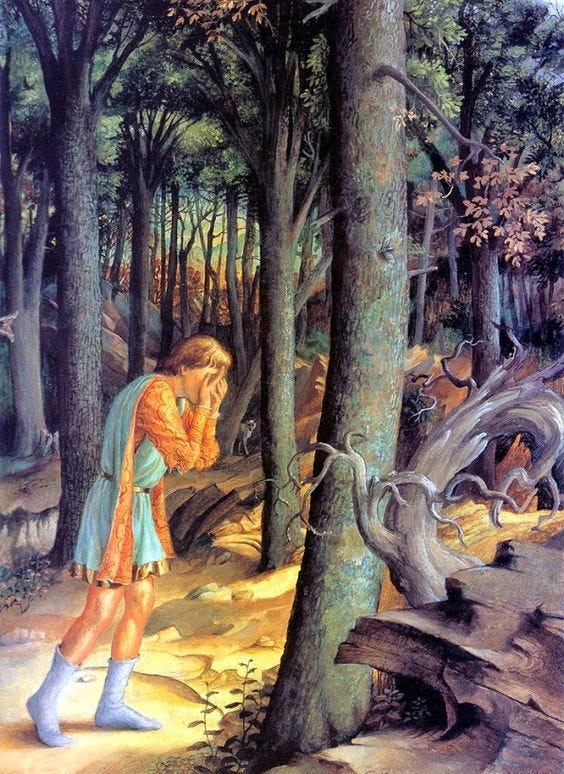
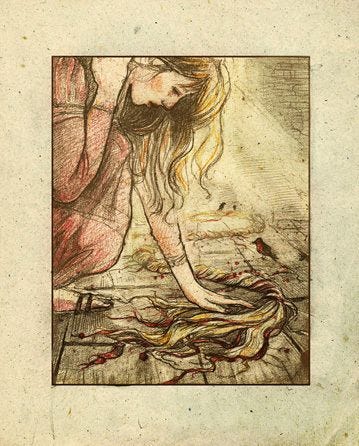
Credit: Paul O. Zelinsky
In the original Grimm tale, Rapunzel’s hair is cut as punishment. For wanting, for choosing, for being sexual. She gets pregnant. The witch discovers it. The hair is cut. She’s banished to the wilderness.
And the prince? He’s blinded.
Not by the witch. By thorns. By the fall.
But the subtext is clear. He’s blinded so he can’t see her “ruined”.
No longer glowing in the tower. No longer untouched. Now she’s in the wilderness - poor, with twins, her beauty “spent.”
He wanders blind for years…
And only when her tears fall on his eyes - only after she’s suffered enough, only after she’s been purified by poverty and motherhood and isolation - only then is he allowed to see her again.
In Grimm, the haircut is punishment for desire. In Disney, it’s framed as liberation.
But the result is the same!! Her glow is removed. And we’re told this is the right ending.

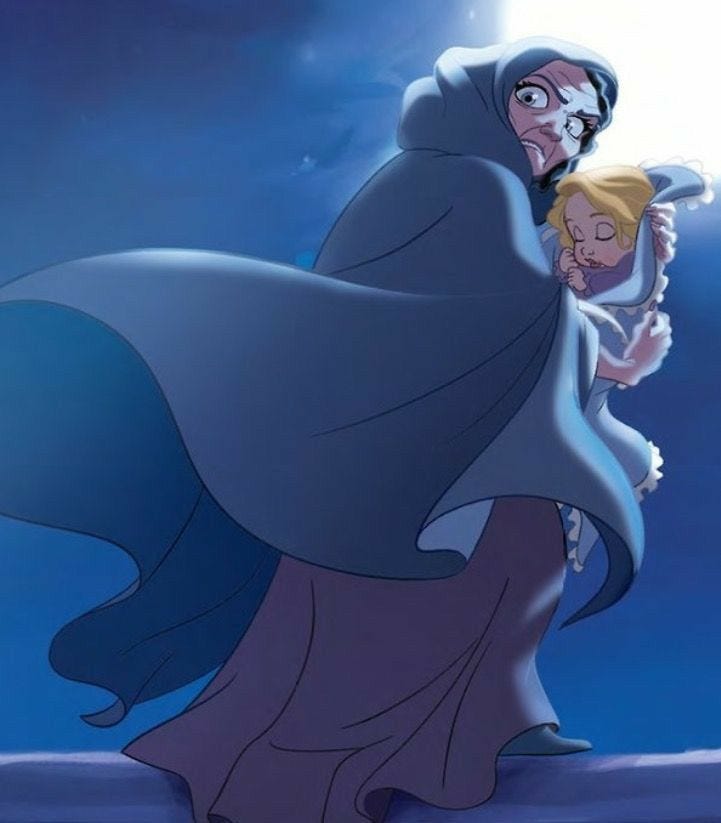
And then there’s Mother Gothel (or Dame Gothel in Grimm). The villain.
She’s punished, not for kidnapping Rapunzel, but for refusing to age out of beauty. She uses Rapunzel’s hair to stay young. To stay glowing. To stay visible.
And we’re told she’s monstrous for it. Why? When we fill our lips with botox, stretch our skin so wrinkles disappear, dye over our grey marker of age and lived experiences? Are we monstrous to do that too? No. Because our world wants us as young as possible. As pure and innocent as possible. As compliant as possible.
Mother Gothel is called monstrous because a woman who refuses to dim herself, who clings to her radiance past her “expiration date,” who won’t gracefully disappear into plainness - she’s the villain.
Even Mother Gothel - the actual kidnapper - isn’t punished for the crime (Which she should. Kidnapping a baby? Absolutely not.).
Instead she’s punished for refusing to fade.
What fucking message is that? A woman who refuses to age out of visibility is more dangerous than one who locks a child in a tower?
Credit: Disney
We don’t allow women to keep what draws desire and fear, especially when it is our own choice, or unapologetic self. Us liberally choosing what we want.
Society demands we give it up - and call it healing.

I refuse to dim myself.
At 25, my grey started coming in. And I stopped dyeing my hair. Deliberately. Out of my own choice. Against everyone’s opinion.
Not because I gave up. Not because I didn’t care. But because I refused to cover what society sees as a flaw. It’s my own sort of rebellion.
Grey equals aging. Aging equals diminishment. Diminishment equals invisibility.
I’m 32 now. And I refuse that script. My grey isn’t a flaw. It’s not something I need to hide to stay relevant, lovable, or powerful.
I’m keeping my glow (literal glow in the hue of silver under sunlight) - on my terms.
Hair, like clothes, is a way to express yourself. And I express refusal.
Refusal to shrink. Refusal to dim. Refusal to trade power for palatability.
Every time I’ve cut my hair, it was MY choice. MY boundary. MY reclamation.
Not his hands deciding when I’m ready.
Not the culture deciding when I’m safe.
Mine.

What would it look like if Rapunzel cut her OWN hair?
What if she left the tower AND kept glowing?
What if her wildness wasn’t something to tame but something to unleash?
What if her aesthetic threat didn’t need to be neutralised to make her loveable?
What if freedom didn’t require ugliness?
We’ve never been given that story. Because we’re still too afraid of girls who glow and don’t apologise.
Girls who are wild AND free.
Girls who refuse to choose between power and love…
This isn’t about fairy tales.
It’s about the scripts we still make women perform. Especially when they’re healing.
Be softer. Be smaller. Be safe to perceive. Be tame enough to marry.
We don’t need another Rapunzel.
We don’t need another glow-down disguised as empowerment.
We need a different story - one where freedom doesn’t require dimming.
Where power doesn’t have to be cut away to make you lovable.
Where wildness isn’t something to lock away - it’s something to keep.
Where your glow is yours.
And no one gets to decide when it’s time to let it go.
Until next Friday,
Stay glowing. Stay undiminished. Stay yours.
- Jen
Postscript (March 20, 2026):
Two hours after publishing this essay, I read DER SPIEGEL’s reporting on Christian Ulmen allegedly stealing his wife Collien Fernandes’s identity for over a decade - creating fake profiles in her name, using her image for sexual gratification, without her consent. He confessed. And men are responding with “innocent until proven guilty.” (Ignoring the fact that The Media Outlet Der Spiegel did EXTENSIVE research; and Ulmen confessed it.)
This is the mechanism the fairy tale warned us about. A man controlling a woman’s identity, her image, her glow - and the system protecting him when she names it.
Rapunzel’s hair was cut by Flynn. Collien Fernandes’ identity was stolen by Ulmen. Both: imposed. Both: framed as something other than what they are. Both: men deciding what version of a woman is acceptable.
The shame belongs on the perpetrator!!!
!! If You Need Support !!
If this piece stirred something painful - exhaustion from dimming yourself for approval, frustration at being told your radiance is “too much,” or the weight of performing palatability - please know you’re not alone, and you deserve care.
Mental Health & Body Image Support
Crisis Text Line (US/UK/CA): Text HOME to 741741 – 24/7 support for overwhelm and emotional crisis
Samaritans (UK): Call 116 123 – 24/7 free confidential support
NEDA (National Eating Disorders Association, US): https://www.nationaleatingdisorders.org – Support for body image struggles and disordered eating
Mind (UK): https://www.mind.org.uk – Mental health resources, including body image and self-esteem support
Lifeline (Australia): Call 13 11 14 – 24/7 crisis support
The Body Positive: https://thebodypositive.org – Resources for body acceptance and liberation
Therapy for Black Girls: https://therapyforblackgirls.com – Mental health resources centering Black women and intersectional experiences
Inclusive Therapists: https://www.inclusivetherapists.com – Find affirming therapists who understand body image, beauty standards, and systemic harm
Feminist & Anti-Ageism Organisations
The Representation Project: https://therepresentationproject.org – Challenging gender stereotypes and media representation
Women’s March: https://womensmarch.com – Advocacy, organising, and community for gender justice
Old Lesbians Organising for Change (OLOC): https://oloc.org – Confronting ageism and ableism in feminist spaces
Collective Care & Community
The Nap Ministry: https://thenapministry.wordpress.com – Rest as resistance, rejecting performance culture
Mutual Aid Hub: https://www.mutualaidhub.org – Find or start local mutual aid networks for community care
You are not too much.
Your glow is not dangerous.
Your wildness is not a flaw.
I can remember as a child my mom always combed my hair in a ugly hair styles. If I mentioned a boy or even looked at one , I was considered a whore. It was the craziest thing to me. To be fair I just wanted a cute hairstyle. I realized early in life that how you look matters. I don't understand the male gaze aspect of child wanting to wear a cute hairstyle. Ironically, I still got attention from boys they used to pull my hair, ick. Those hair styles indirectly affected my self esteem. I learned very early how to comb my own hair. This was done to give my mom the middle finger but most of all I wanted the freedom to wear my hair anyway I choose. Trust me, until this day I'm still considered the wild child. My point is I see all the ways women are asked to play small and we are groomed this way as children. We don't need to be quiet to exist and if we aren't we are often punished. The article is very thought provoking.
This is powerful. The idea that “freedom requires dimming” is something so many women quietly live with.
I love your refusal — keeping your glow, on your terms.