


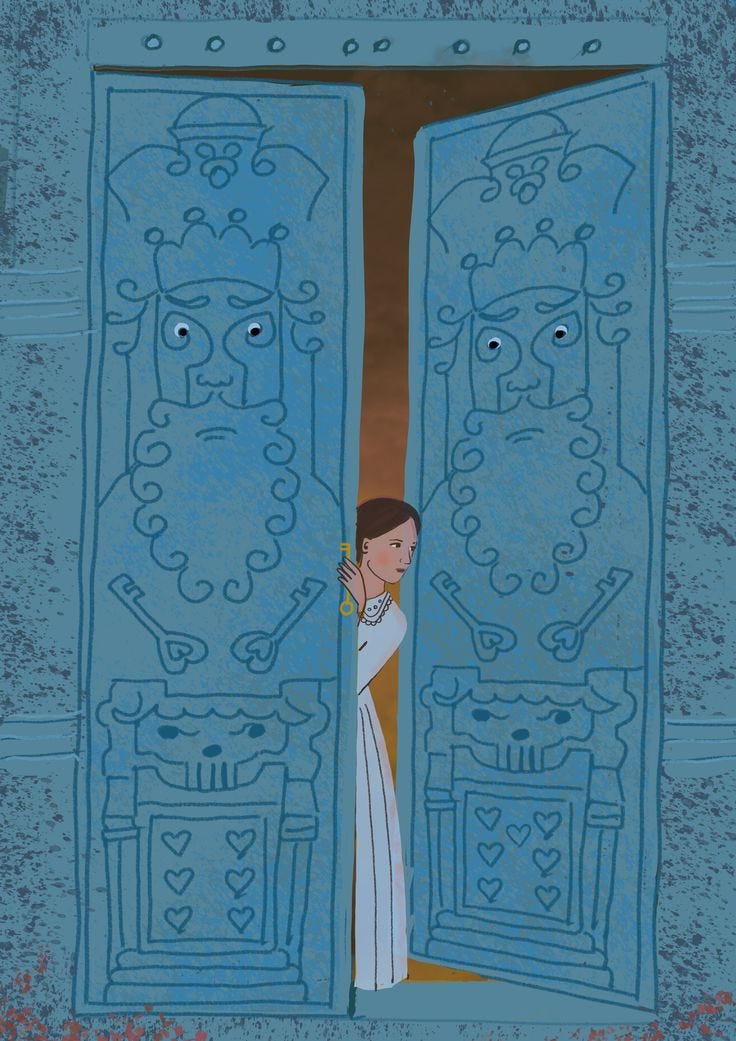
There’s a room in Bluebeard’s castle full of dead wives.
He keeps the door locked. Keeps the key close. And when he marries again, he hands that key to his new bride with a single rule: you can go anywhere, open any door, explore the entire castle.
Just don’t open this one.
Then he leaves.
And when she opens it anyway (because of course she does), when she finds the bodies hanging on hooks, when the magic key bleeds in her hands and won’t stop bleeding no matter how hard she scrubs, when he returns and sees the evidence and tells her she must die like the others did?
The story calls it disobedience.
I call it survival instinct.
⚠️ Trigger Warning
This essay discusses intimate partner violence, murder, psychological manipulation, and the systematic punishment of women for discovering men’s secrets. If you’re navigating your own experiences with hidden abuse or gaslighting, please read with care.
Bluebeard is a fairy tale about a serial killer who marries women, murders them, and hides their bodies in a locked room.
But it’s told like a cautionary tale about female curiosity.
Let me tell you the whole story. Because the details matter.
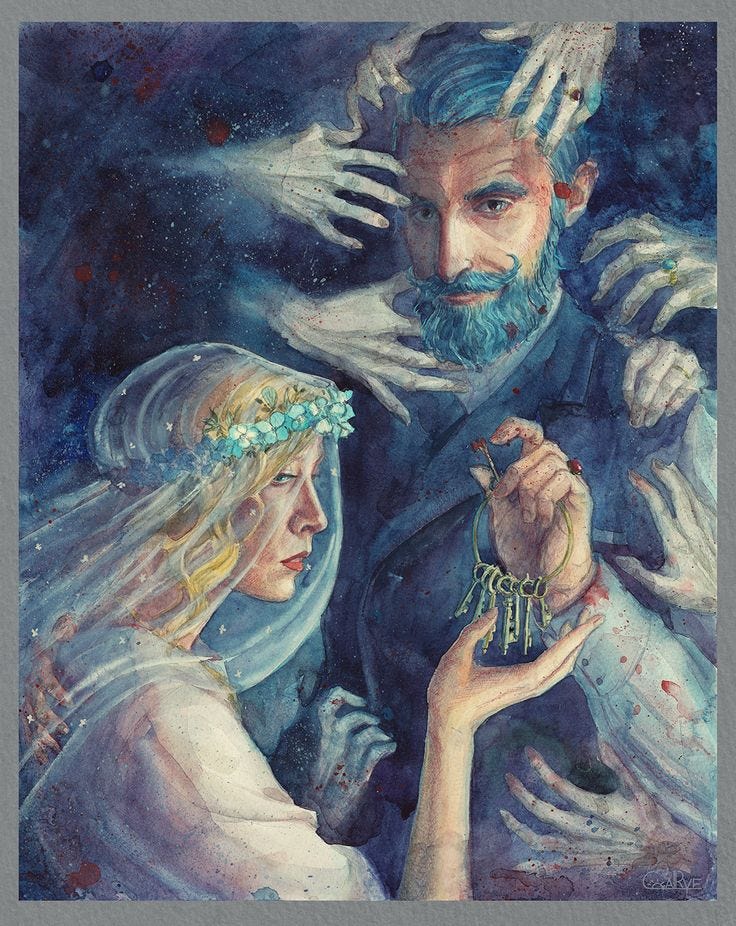
Bluebeard is a wealthy nobleman with a literal blue beard. It makes him ugly, frightening. He has been married multiple times. All his previous wives have disappeared. No one knows where they went.
He courts a young woman. She is hesitant. He is scary. Where ARE all those wives?
But he is rich. Charming when he wants to be. Persuasive.
She marries him. (Hold that thought. We’ll come back to it.)
Shortly after the wedding, Bluebeard announces he has to travel. Hands her a ring of keys. “You can go anywhere. Open any door. The entire castle is yours to explore.”
“Except this one room. Never open this door.”
He gives her the key anyway. Then he leaves.
She resists for a while. Days, maybe. But the prohibition gnaws at her. Why that room? What’s in there? Why give her the key if she can’t use it?
Finally, she opens the door.
Inside: the bodies of all his previous wives. Murdered. Hanging on hooks. Blood everywhere.
The key is magic. It bleeds when it opens that door. She tries to clean it. Scrubs, wipes, panics. The blood won’t come off.
Bluebeard comes home early. Sees the bloody key. Knows immediately what she’s done.
“You disobeyed me. You opened the forbidden room. Now you will die like the others.”
She begs for time to pray. Secretly signals her brothers. They arrive just in time, kill Bluebeard, save her life.
She inherits his wealth. Remarries a “good man.”
The end. (Fantastic story - right?)

Now.. let’s talk about that key.
Bluebeard didn’t have to give it to her. He could have hidden it. Destroyed it. Kept the room locked forever and never mentioned it.
But he gave her the key. And told her not to use it.
This is psychology 101.
Forbidden fruit. Reactance theory. Tell someone not to do something, give them the means to do it, and wait.
He set her up. (Of course he did)
If she obeys and doesn’t look, she stays ignorant. Lives in a castle with a room full of corpses she doesn’t know about. Becomes dead wife number six eventually. It just takes longer.
If she disobeys and looks, he has his excuse to kill her NOW. She violated his trust. She was curious. Disobedient.
She cannot win.
The forbidden room isn’t a test of obedience. It’s a trap with two doors and both lead to her death.
The only reason she survives? Luck. Her brothers happened to be nearby.
Not because she made the right choice. There was no right choice.
You know what the modern version of the forbidden room is?
“I’m not hiding anything, but don’t go through my phone.”
He leaves it unlocked. Password shared. Access granted.
But tells you not to look.
Plants the seed of doubt.
If you look and find nothing, you are paranoid. Controlling. Violated his privacy.
If you look and find something (the affair, the financial fraud, the abuse, the secret family, the evidence), you are STILL the villain. Because you looked.
You weren’t supposed to know.
And now that you do, HE’S the victim. You invaded his space. You didn’t trust him. (Never mind what he actually did. The crime is your discovery of it. But we know that spiel by now do we?)
The forbidden room is whatever he’s hiding.
The second phone. The locked laptop. The “work trip” with no details. The DMs he deletes. The bank account you don’t know about.
And women are taught the same lesson Bluebeard’s wife learned:
Don’t look. Don’t ask. Don’t know.
Because knowing gets you punished. Sure, maybe not murdered (though sometimes, yes, murdered). But punished.
Called controlling. Paranoid. A snoop. Crazy. Gaslit into doubting your own fucking instincts.
And here’s the thing: those instincts? They are usually right!
Something felt wrong to Bluebeard’s wife. The missing wives. The forbidden room. The key he gave her with instructions not to use it. Her body subconsciously noticed a pattern and too many open variables.. and that sank into her stomach.
Her curiosity was never a flaw. It was survival instinct! And as we find out rightfully so!
She opened that door because something was deeply, dangerously wrong.
And she was right.
While I was going through this story and starting to note the Psychology 101 I couldn’t help but notice some other layer that pops up.
The “gold digger” argument.
Because I can already hear it: “She married him for money. She is a gold digger. She deserves what she got.”
Let’s be abundantly clear about something.
In the world this fairy tale comes from, marriage was an economic proposition for women. Not romance. Not partnership. Survival.
Women couldn’t own property. Couldn’t work most jobs. Couldn’t support themselves.
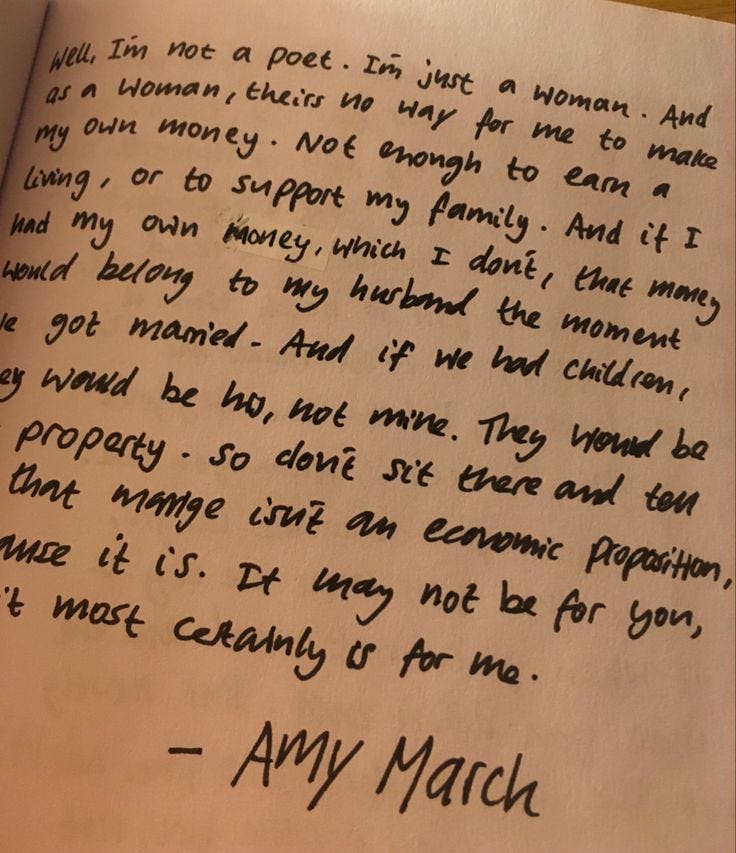
Quote: Little Women by Louisa May Alcott
Marriage was how you didn’t starve.
So yes, she married a rich man. A scary, ugly rich man whose previous wives disappeared under mysterious circumstances.
Because what were her other options?
But here’s what the “gold digger” framing does: it makes HER the villain of this story.
She married for money (survival). He murdered multiple women and hid their bodies in a locked room.
Guess which one the story questions.
She is curious. Disobedient. Materialistic. He is a literal damned serial killer.
But somehow she is the one whose motives we are supposed to examine??

The crazy proportionality of it all
She opened a door.
He planned to murder her for it.
The punishment doesn’t fit the crime. Don’t you think?
And yet the fairy tale frames her disobedience as the problem. Not his violence. Her curiosity.
You know what is wild to me? Men tell women we are too emotional. That we overreact. That we are hysterical and dramatic and can’t handle conflict rationally.
But a man literally planned to MURDER his wife for opening a fucking door.
She looked in a room. He kept a morgue in his basement.
So who is emotionally reactive again?
The proportionality is insane. And it’s everywhere.
She raises her voice in an argument. He throws things, punches walls, threatens her.
But SHE’S the one who’s “too much.”
She questions him. He rages, controls, isolates, punishes.
But SHE’S the one who’s difficult.
The forbidden room teaches women, that your disobedience (curiosity, questions, boundary-setting, self-protection) will be met with disproportionate punishment.
And you will be blamed for provoking it.
And that Ending?
The story says: Bluebeard dies. She inherits his wealth. She remarries a “good man.” She lives happily ever after.
But let’s be honest.
If you survived a husband who murdered his previous wives, hid their bodies in a locked room, gave you a trap disguised as a test, and tried to murder you when you discovered his violence?
Would you actually remarry?
Would you trust another man enough to marry him? Would you hand over your autonomy, your life, your safety to someone else again?
Or would you take Bluebeard’s money, buy your own castle, lock your OWN doors, and live alone? (I personally would take inspiration from Enya and just live in solace with my cats in a castle)
The fairy tale can’t imagine that ending.
A woman. Wealthy. Independent. Alive. And single?
Unthinkable.
So it marries her off again. Because a woman’s happy ending requires a man.
Yep, even after the last one tried to kill her.
The story can’t let her be alone. Can’t let her be enough on her own.
Because if she doesn’t need a man to be happy, what was the point of surviving Bluebeard?
The point, apparently, was to find a better man.
Not to trust yourself. Not to build a life on your own terms. Not to recognise that you saved yourself (with help) and you can keep yourself safe.
No. The point is: try again. This time with a good one.
As if that’s guaranteed.
As if “good men” don’t also have forbidden rooms sometimes.
The bottom line is that Bluebeard isn’t a fairy tale about curiosity. It’s a fairy tale about what happens when women discover men’s violence. She is not punished for disobedience. She is punished for knowing.
The story teaches: don’t look, don’t ask, don’t discover his secrets. Your curiosity will get you killed. But the truth? It is looking or knowing or learning is what gets you killed.
Bluebeard’s wife survived because she opened that door. Because she trusted her instincts. Because she KNEW something was wrong and she looked anyway.
And yes, she needed luck (her brothers). She needed help.
But she also needed courage.
The courage to disobey. To look. To know.
The forbidden room is still here. Different doors. Same traps.
You are told to not be paranoid. To not invade his privacy. To trust him.
And when you do look and find the bodies (literal or metaphorical)? You are the villain.
AND YET.. here is what Bluebeard’s wife teaches us.
Open the door anyway.
Trust your instincts. Look. Know.
Yes, there will be consequences. Yes, you might be called controlling, paranoid, a snoop.
But at least you will be alive knowing. Because not knowing, ambiguity dressed up as care? That is simply ignorance that leads to control.
And you don’t need to remarry to have a happy ending.
Sometimes the happiest ending is for you to survived, to have your own castle, and all the doors are YOURS to open or lock.
Until next week,
Trust your instincts. Open the door. You don’t owe anyone your ignorance.
– Jen
!! If You Need Support !!
If this piece stirred something painful - if you’re navigating a relationship where you are punished for asking questions, discovering secrets, or trusting your instincts - please know you’re not alone.
Crisis & Emotional Support
Crisis Text Line (US/UK/CA): Text HOME to 741741
Samaritans (UK): Call 116 123
Mind (UK): https://www.mind.org.uk
NAMI (US): https://www.nami.org
Lifeline (Australia): Call 13 11 14
Survivors of Sexual & Domestic Abuse
RAINN (US): 1-800-656-HOPE (4673)
National Domestic Violence Hotline (US): 1-800-799-SAFE (7233)
Refuge (UK): 0808 2000 247
Women’s Aid (UK): https://www.womensaid.org.uk
Victim Support (UK): https://www.victimsupport.org.uk
BetterBrave (US): https://www.betterbrave.org
Therapy Resources
Therapy for Black Girls: https://therapyforblackgirls.com
Inclusive Therapists: https://www.inclusivetherapists.com
Your instincts are not paranoia. Your questions are not controlling. Your discovery of the truth is not the crime.
I do definitely know that feeling when my gut is screaming something is horribly wrong and it gets trivialised! thanks for writing this
Loved this, so true!